
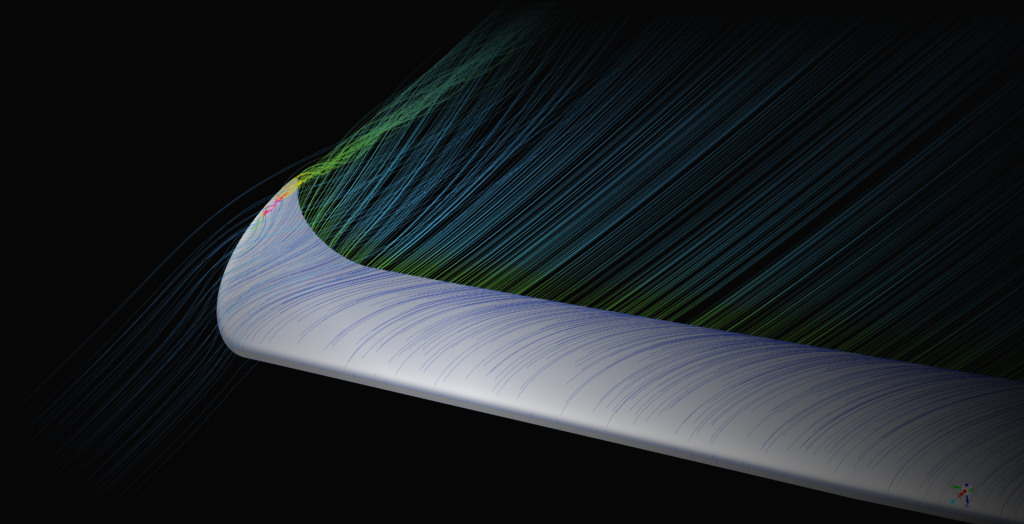
This image shows the wingtip vortex and how it propagates in the wake of the wing during a Vy climb condition.
The aircraft is climbing, the wing is working hard, and the airflow near the wingtip is becoming highly three-dimensional. This is exactly where a lot of useful aerodynamic information is hidden.
For our Cessna winglet development, this is one of the most important areas we study. The wingtip vortex is closely connected to induced drag and wing efficiency, both of which matter a lot during climb. And yes, we still dislike induced drag more than a Cessna dislikes a hot summer climb. Professionally, of course.
A good winglet helps manage this vortex. But the shape matters a lot.
For this project, we are not simply chasing drag reduction. Our development focus is to increase useful lift without creating a drag penalty, especially in climb-relevant conditions.
That is why we are developing a blended winglet. The smooth transition between the wing and the winglet helps reduce interference drag at the junction. If this transition is too sharp or does not match the wing properly, it can disturb the airflow and add drag in a different place.
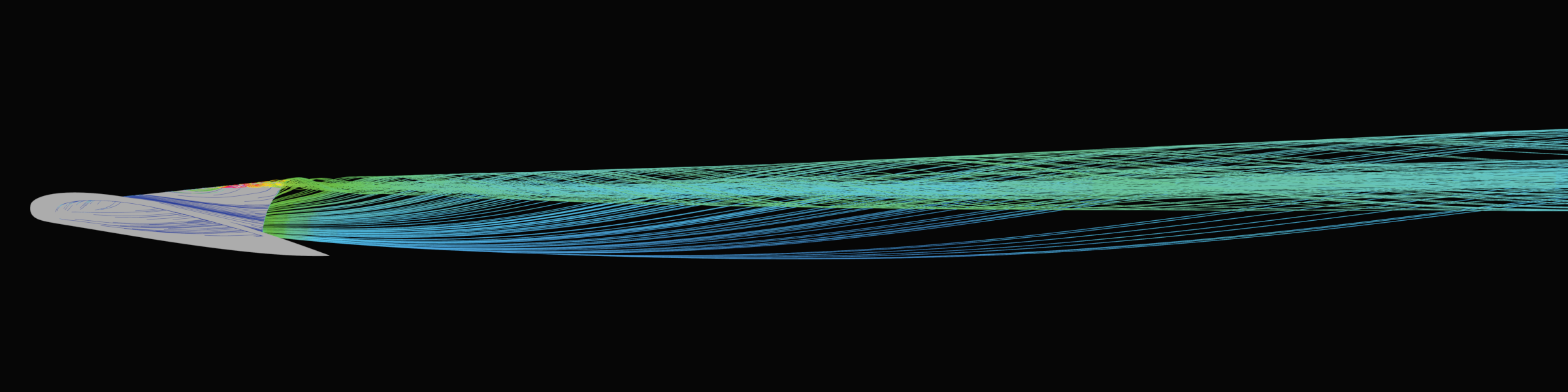
At Skyhawk Aviation, we use high-fidelity CFD simulations with Ansys tools, including the GPU solver. This allows us to run very large simulations much faster than with a traditional CPU-only setup. Our GPUs can deliver compute performance comparable to several hundred CPU cores while handling large meshes.
This case is close to 30 million cells, using a poly-hexcore mesh. It gives us a good balance between complex geometry handling, and overall accuracy.
We run the simulations in double precision and use the widely applied k-ω SST turbulence model, which combines accurate near-wall flow handling from k-ω with the efficiency of k-ε farther away from the aircraft.
We also run many iterations until the solution changes only by a fraction of a percent between calculation steps. In simple terms: we wait until the simulation stops changing its mind.
This is how we work toward a winglet that is not only good-looking, but also properly engineered for real Cessna operations.
Skyhawk Winglet – EASA STC certification in progress
Cessna 172, 182 and 206 applications planned.